
LVL Wellbeing enhances mental and physical health through live and on-demand wellness content, personalized programs, and team-based wellbeing initiatives.
My role
Lead Product Designer
User research, discovery, prototyping, UI design
Built and maintained the design system (English & Arabic)
Designed data visualizations to improve engagement
Platform
Web & Mobile
Timeline
2 years

Problem & Ambiguity
As LVL grew, the platform offered an increasing number of features, content types, and wellbeing metrics. While engagement was strong, users often struggled to understand how different features connected to their personal wellbeing goals.
Internally, there were competing assumptions about what users valued most—content consumption, daily habits, social interaction, or data insights. Externally, users expressed confusion around what actions to take and how to interpret their progress.
The challenge was not adding more features, but creating clarity in a complex and emotionally sensitive domain.

Research Goal
As the platform scaled, the primary goal was to understand how users perceived wellbeing features, data, and social interactions—and where confusion or friction occurred.
Key Questions
How do users interpret wellbeing data and progress metrics?
What drives consistent daily engagement without overwhelming users?
Where do users feel unsure about what action to take next?
How comfortable are users with social and team-based wellness features?
Research Synthesis & Key Insights
Synthesis & Patterns
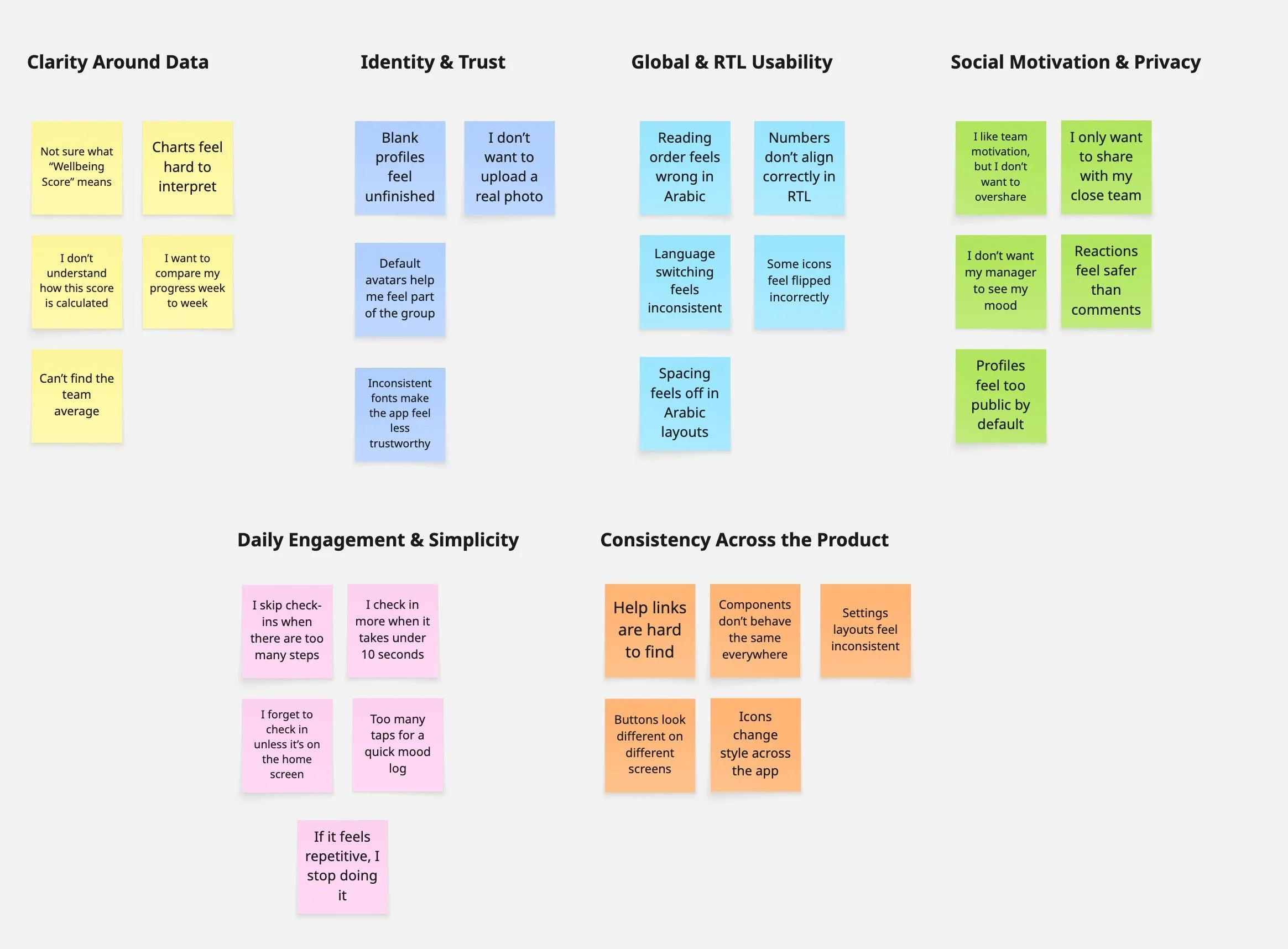
Findings from interviews, surveys, and walkthroughs were synthesized using affinity mapping to identify recurring themes across user needs, behaviors, and pain points.
Through this process, several consistent patterns emerged:
Key Insights
Users struggled to interpret raw wellbeing data, which led to designing Champion Metrics and simplified data visualizations that emphasize trends and summaries over detailed analytics.
Consistent daily engagement increased when interactions felt lightweight and low-commitment, directly informing the design of the Daily Check-In widget.
Users valued social motivation but required strong boundaries around privacy, shaping the structure and interaction model of the Teams feature.
Empty or generic profiles reduced trust in social spaces, leading to the introduction of customizable profile pictures to support identity without forcing uploads.
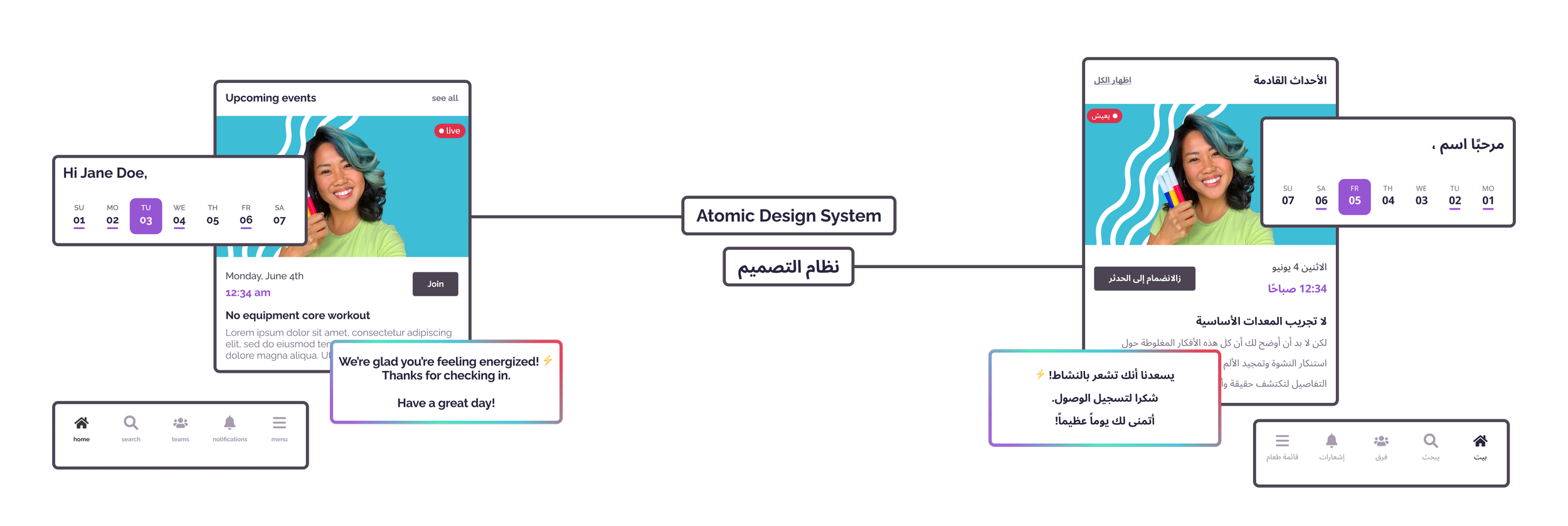
Inconsistencies across screens increased cognitive load as the product scaled, reinforcing the need for a shared atomic design system.
Arabic-speaking users needed more than mirrored layouts, driving the creation of a fully considered RTL design system rather than a simple visual flip.

Scalable Design Systems (LTR & RTL)
Identified UI inconsistencies through pattern audits and usability reviews, prompting the creation of a shared atomic design system.
Designed a fully mirrored Arabic (RTL) system based on usability walkthroughs, ensuring global usability and consistency.
Teams: Social Engagement with Clear Boundaries
Research showed users wanted social motivation with strong privacy and low complexity.
Designed a dedicated Teams experience with pop-out navigation and lightweight reactions to support engagement without disrupting core flows.

Daily check in widget— Promoting Daily Engagement and Self-Reflection
Simple, low-commitment interactions increased daily engagement.
Designed a lightweight check-in to reduce cognitive load.


Profile Personalization & Trust
Empty profiles reduced trust and social participation.
Introduced customizable avatars to support identity and inclusion.
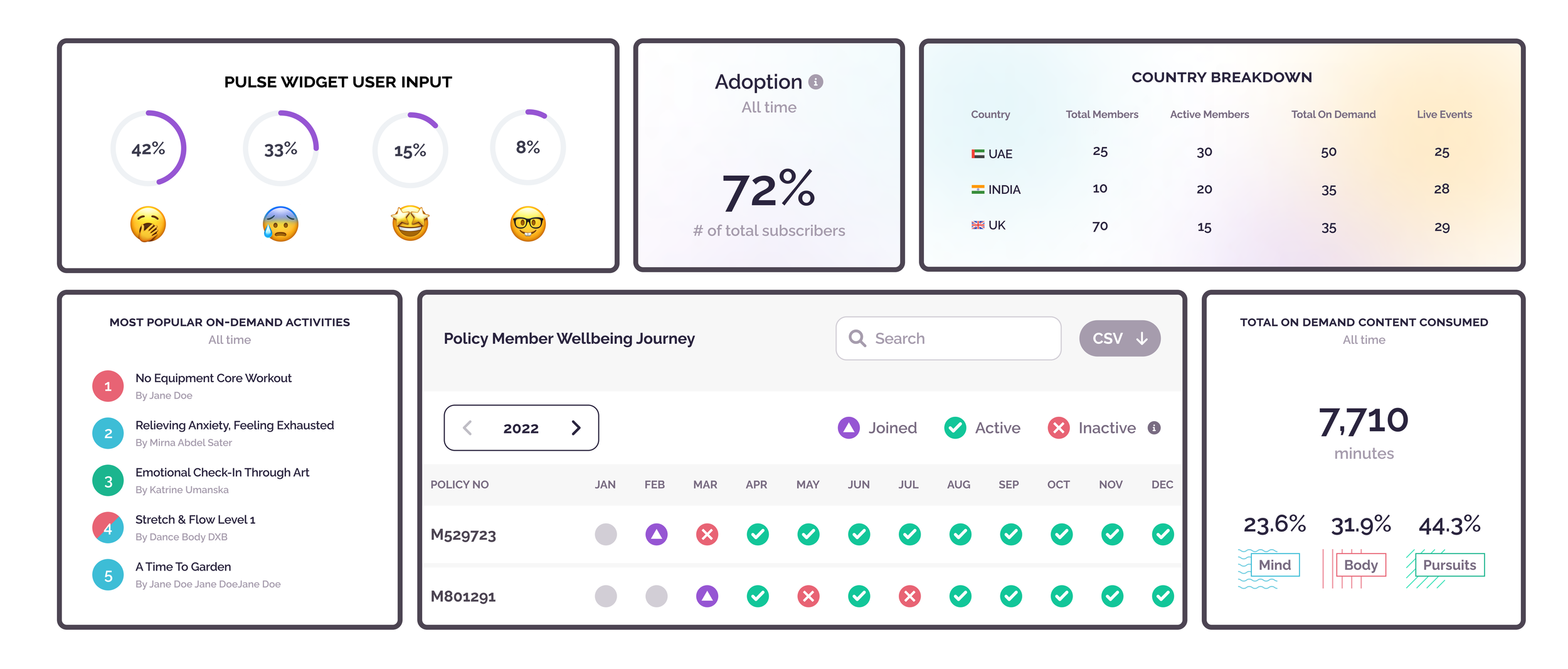
Champion Metrics: Actionable Insights at a Glance
Champions needed fast insight, not deep analytics.
Designed simplified dashboards focused on trends and signals.

+89%
Post-launch survey indicated that 89% of users found wellbeing data easier to understand.
2X
2× increase in daily check-in participation
+30%
Adoption of Teams features increased by 30% after introducing dedicated navigation and simplified interactions.
This project reinforced the importance of designing for clarity in complex, emotionally sensitive products. By grounding decisions in user research, synthesizing insights into clear principles, and validating solutions through testing, the platform scaled without increasing cognitive load.
The result was a system that supports daily engagement, meaningful social interaction, and actionable insights—while remaining flexible enough to grow across teams and global audiences.